1500i 2WD
A 2WD inertia dynamometer for power runs without an electromagnetic retarder. An entry point into the DYNOmax range for a single driven axle.
Enquire about this model ↗Specifications ↓ PRODUCT IMAGE / EQUIPMENT MAY VARY
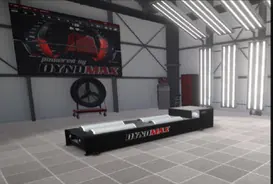
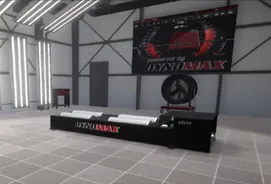
One model. More perspectives.
Views from the manufacturer's 2026 catalogue. The exact equipment is agreed for your project.

The facts.
In detail.
Specifications from the manufacturer’s 2026 catalogue. Power limits relate to different test modes and are not interchangeable.
Vehicle suitability, scope of supply and required infrastructure are clarified before an order.
| Measurement principle | Inertia |
|---|---|
| Drive configuration | 2WD |
| Max. speed | 300 km/h |
| Roller diameter | 350 mm |
| Max. axle load | 3,000 kg |
| Dimensions (L × W) | 1,220 × 3,620 mm |
| Max. inertia power | 800 hp |
| Power supply | 220 V |
| Compressed air (minimum) | 8 bar |
Configured for your application.
The manufacturer’s catalogue lists DynomiZer Wireless software and Omron sensors. WiFi modules for lambda, OBD and weather data are listed as options.
The catalogue describes above-ground and pit installation. The appropriate arrangement depends on the building, vehicles and intended operation.
Power runs with one driven axle
The 1500i 2WD uses the inertia principle: acceleration of the dynamometer rollers is evaluated to determine power. Unlike the 1500BRD, no electromagnetic retarder is specified for this model. It is intended for projects focused on inertia power runs with a single driven axle.
The manufacturer specifies up to 800 hp inertia power and a maximum speed of 300 km/h. These limits do not replace a vehicle compatibility check. Tyres, track width, permitted axle load and drivetrain requirements must be matched to the platform.
When should you compare it with the 1500BRD?
If your work also calls for controlled load conditions, consider the braked 1500BRD. The right choice depends on the measurements you expect to perform regularly. The 1500i has a stated platform footprint of 1,220 × 3,620 mm, a 220 V power supply and a minimum compressed-air requirement of 8 bar. Additional room is needed for the vehicle, cooling and a safe working area.
What to prepare for planning ↗Ready for your
own test station?
Tell us what you want to test.
Let’s discuss the right configuration.